


HUMAN RESOURCES AND MANAGEMENT STRATEGIC PLAN | INCLUSIVE EXCELLENCE STUDENT STUDENT CLUB
A candid conversation on representation and resilience
February 20, 2026 ·
Contributed by: Angelica Babiera
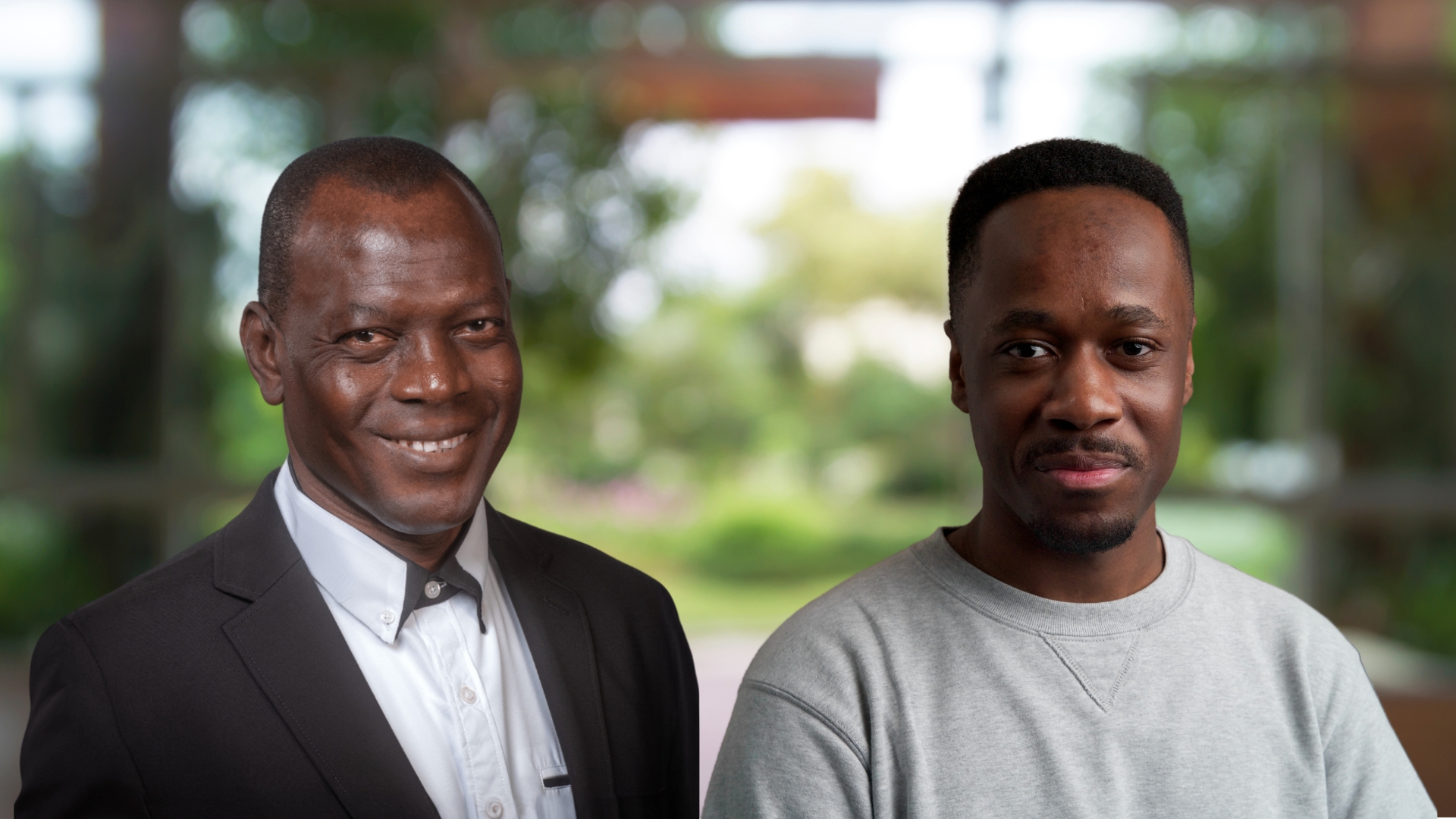
As part of this year’s Black History Month, Andrew Rouse and Baniyelme Zoogah sat down to share their stories and experiences as two Black professionals at different stages of their careers. Together, they reflected on identity, representation and the shifting landscape of diversity in business and academia.
Baniyelme Zoogah is a professor and area chair of Human Resources and Management at the DeGroote School of Business, where his research spans leadership, organizational behaviour, strategic alliances and environmental sustainability. Zoogah’s work explores how individuals, organizations and societies develop across micro and macro domains, ranging from human resource practices to international business and historical perspectives on management.
Andrew Rouse, a fourth-year Commerce student, is president of the DeGroote Marketing Association (DMA) and an aspiring marketing professional preparing to enter an increasingly complex workforce.
The conversation was candid and centered on resilience, responsibility and what it truly means to “brighten the world.” Listen to their full conversation below.
Excellence as expectation
For Rouse, identity has shaped his approach in a quiet but insistent way.
“For me, being Black has affected my studies and also my career in the way I make sure that we approach everything with a level of excellence,” he said. “I make sure that I put my all into whatever I’m doing.”
Excellence, for him, is both a shield and aspiration. It was a way to ensure that whatever he builds is something “I can be proud of and look back on.”
As for Zoogah, his journey spans continents. He first studied in Africa and later pursued his studies in the United States, where race became newly visible in ways it had not been before.
“The experiences in Africa are completely distinct from the experiences abroad,” he said. In North America, he became acutely aware of how “you are treated in class, how your professors regard you, and how they relate with you.”
Those early experiences now shape his philosophy in the classroom.
“Based on those experiences, I try to make sure that my students never experience the same thing that I encountered when I was a student,” he said. “It is essentially trying to correct the error through the work that I do.”
This is why Zoogah believes inclusion does not end in recruitment. It continues in how students are treated once they arrive; in how they are challenged, supported and seen.
If students think of professors primarily as lecturers, he hopes they reconsider.
“The one thing that students don’t often realize is how much a professor can impact or change their lives beyond the classroom,” he said.
Teaching, in Zoogah’s view, is not only about transferring knowledge. It’s about shaping character and influencing “the person’s behavior, the person’s affect and the person’s attitudes as well as cognitions.”
Opportunity and being sought
If excellence is the standard both men carry, opportunity is what determines whether they ever get the chance to prove it. For Zoogah, that opportunity came through the Black cohort hire at McMaster, an initiative designed to increase faculty representation and demonstrate a commitment to inclusion.
“If that hadn’t been there, I would not have come to make my mark,” he said. It wasn’t just a hiring program. It was a signal that representation mattered enough to be pursued intentionally.”
Rouse now finds himself on the other side of that equation, scanning job postings and corporate messaging as he plans his next steps. He looks for that same sense of purpose.
“When you’re looking at an opportunity, you really have to dig deeper into what that community is like and what they offer in terms of allowing you to grow,” he said.
For him, growth and belonging go hand in hand. An opportunity that offers one without the other is incomplete.
That pullback in the corporate world feels personal and consequential. In the years following the pandemic and the rise of the Black Lives Matter movement, many companies made sweeping promises about equity and representation. But in some cases, those commitments have quietly faded.
“If they really meant it, regardless of what they encountered, they would have stuck to their guns to say, ‘this is important for us’,” Zoogah said of organizations that have eliminated Equity, Diversity and Inclusion (EDI) efforts.
For Rouse, the shift is not abstract. It shows up in the companies he researches and the signals he reads between the lines during job interviews.
“When companies make all this big hubbub but then quietly take things back, it’s something that we notice,” he said.
Students entering the workforce are paying attention. Corporate values are not just language on a website; they are clues about whether belonging will be real or simply rehearsed.
Looking ahead
When asked about the future, Rouse emphasized impact.
“My main goal is just making sure that the work I put out there is something I can be proud of and provides impact to not only the people I work with, but people across the world as well.”
For Zoogah, his vision is institutional and expansive. “If you truly want to brighten the world, you have to make it open to all groups of people,” he said.
In their exchange, the distance between student and professor felt less like a divide and more like a continuum: it was two generations navigating the same upward trajectory, with determination and a focus on impact.



Thank you, Baniyelme and Andrew–this was a wonderful conversation!