

FINANCE AND BUSINESS ECONOMICS STRATEGIC PLAN | TEACHING AND LEARNING
Turning the classroom into an investment bank
July 7, 2026 ·
Contributed by: Izabela Shubair, DeGroote contributor

One team has raised its bid by hundreds of millions of euros. Another is refining a financing package, balancing risk against return. Across the table, a third is weighing which offer to accept. As the clock ticks, the outcome of the transaction comes down to one question: how much is this company really worth?
It’s the kind of high-pressure negotiation that happens in investment bank boardrooms. But instead of unfolding on Bay Street, it’s happening in a DeGroote Master of Finance (MFin) classroom.
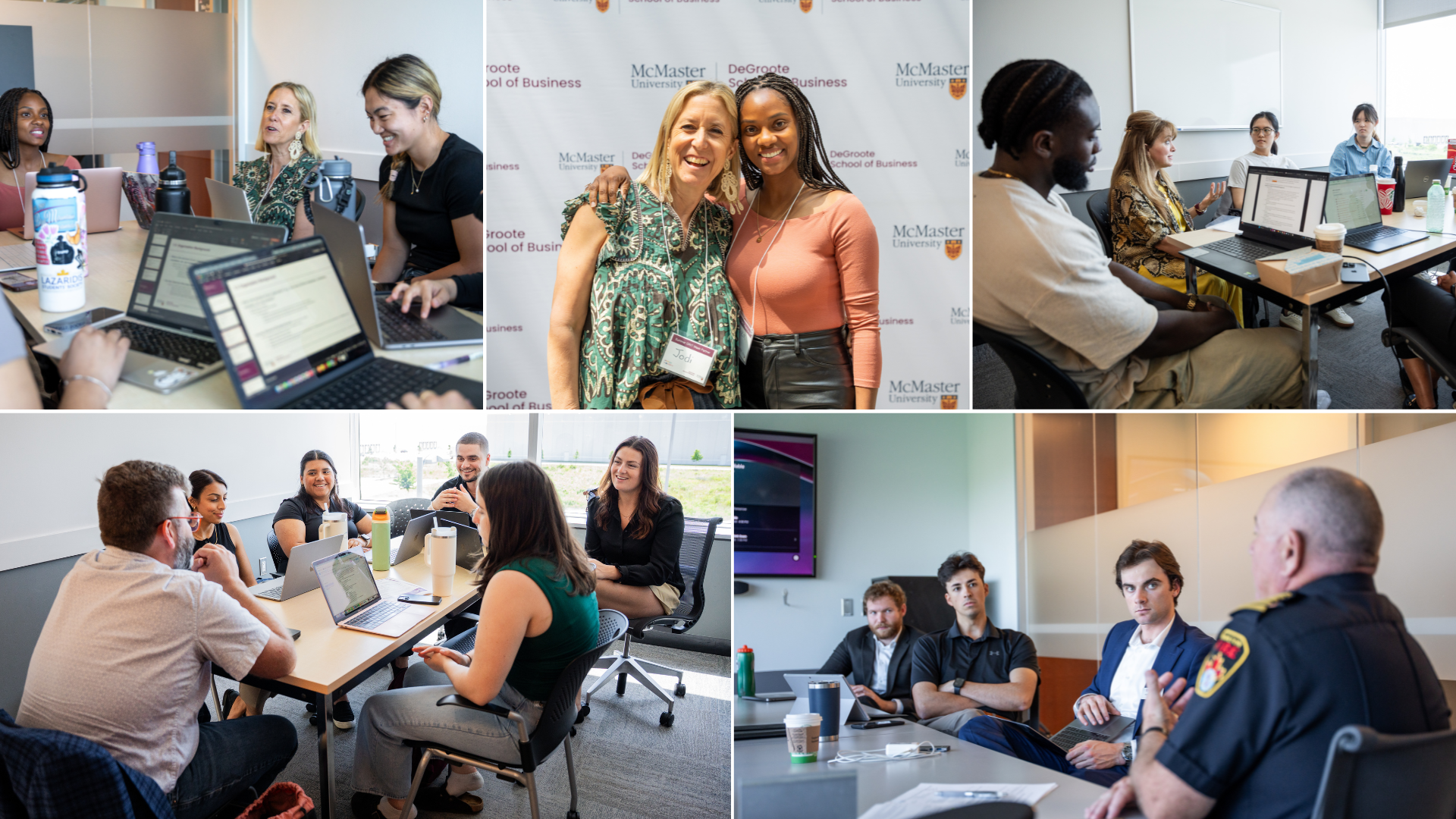
In the second-term Financial Theory course, students step into the roles of buyers, sellers and lenders through Finsimco, an immersive banking simulation that replicates an investment bank’s core activities. Students analyze companies, build financial models, evaluate strategic options and make advisory decisions across areas such as mergers and acquisitions, capital raising and valuation.
“Instead of reading about finance, we were in the driver’s seat,” says Yogesh Kumaar Panjwani, whose team recently placed first overall. “We valued the companies, pitched buyouts and negotiated with lenders, often within a three-hour window. We also made mistakes that we only realized afterward, but that’s what made it valuable.”
Why experiential learning matters
Introduced three years ago, the Finsimco simulation reflects a broader shift in how finance is taught at DeGroote. The MFin program is moving beyond traditional theory and case studies to bring students closer to the realities of an industry that’s integrating artificial intelligence, blockchain and automated services.
For Peter Miu, MFin’s acting director, such trends make experiential learning essential.
“The financial market is becoming more complicated with new instruments and players, and things are changing quickly,” he says. “We need to keep up with new developments that may not be reflected in traditional theory. Finance is also highly data-driven, but students need to understand the nuance behind the numbers. Finsimco is one way students develop that understanding.”
Andrew Aziz teaches the Financial Theory course and echoes that emphasis. Despite the course’s theoretical focus, he says students need to understand how to apply financial concepts in practice.
“At the end of the day, analytics is the easy part; it’s how you apply it that matters,” he says. “You can go very deep into theory, but unless students can see where and how it’s used, they won’t get the same value from it in their first job.”
Finsimco makes up 30 per cent of his students’ final grade.
Inside a financial simulation
If the goal of experiential learning is to connect theory with practice, Finsimco brings that idea to life.
The simulation is delivered through a platform developed by former investment bankers as a training tool for industry professionals. Over four weeks, students work in teams to manage a full investment banking process across the lifecycle of two companies over multiple simulated years.
“Because the simulation centres on mergers and acquisitions, analysis is key,” says Aziz. “Students have to balance the pressure to win a deal without straying too far from the analytics they have. If they overpay early, it creates challenges when they have to sell later. It develops critical thinking, deal structuring, negotiation and collaboration skills.”
Early on, students evaluate companies while also making financing and valuation decisions. As the simulation progresses, roles shift. Some teams move into a sell-side position after acquiring a company, while others remain on the buy side, competing for new deals and adjusting strategy.
Later stages become more negotiation-focused, with lenders, buyers and sellers interacting directly to structure deals and agree on terms. Decisions are driven not just by valuation, but also by risk, timing and competition.
By the final stage, students work through more complex outcomes such as restructuring and broader risk considerations, reflecting real-world investment banking.
“Employers look for graduates who already understand how the business works — its products, its terminology and how decisions are made,” says Miu. “Those are things that are often learned on the job. Because students go through that process at least once in this simulation, they can contribute more quickly when they enter the industry.”
The student experience
For students, the value of Finsimco isn’t just in understanding how a deal works; it’s in navigating uncertainty.
Working across both buy-side and sell-side roles, teams go beyond textbook analysis and into judgment calls. Assumptions don’t always hold, competitors behave unpredictably and negotiations introduce variables not fully captured on spreadsheets.
“I think students become uncomfortable when they expect one right answer,” says Aziz. “The reality is in negotiations there is also a collaborative aspect, a behavioural aspect that makes it much more nuanced.”
Kyle Newcombe was on Panjwani’s team, along with Sharina Pratheepan and Chun Huan Wei. He says one of the biggest takeaways was the shift from clean case analysis to layered complexity.
“It started out manageable,” he says. “But as the simulation progressed, we realized everything was connected. The assumptions we made early on carried through, and each round added another layer of complexity. We also had to act in real time.”
Adds Panjwani, “Theory gives you a framework, but with Finsimco you have to explain your logic. You’re also thinking about the other side’s perspective, how they may react and where you’re willing to compromise.”
By the end of the simulation, both students say they had gained more than technical confidence. They had a clearer sense of how deal environments function and how much of that extends beyond the numbers.
“We were learning much more than applying financial modelling,” says Panjwani. “We were learning to navigate high-pressure deals, which include back-and-forth that requires you to communicate your ideas clearly, know when to compromise, actively listen, and ask the right questions. Those skills are universal.”