

INFORMATION SYSTEMS SOCIETAL IMPACT STRATEGIC PLAN | OPERATIONAL EXCELLENCE STRATEGIC PLAN | RESEARCH AND SCHOLARSHIP
Pushing the boundaries of AI
March 24, 2026 ·
Contributed by: Julienne Isaacs

Yufei Yuan, a professor of Information Systems at DeGroote, has been studying AI, neural networks and automated reasoning since the 1990s.
But he’s been interested in emerging technologies his entire life.
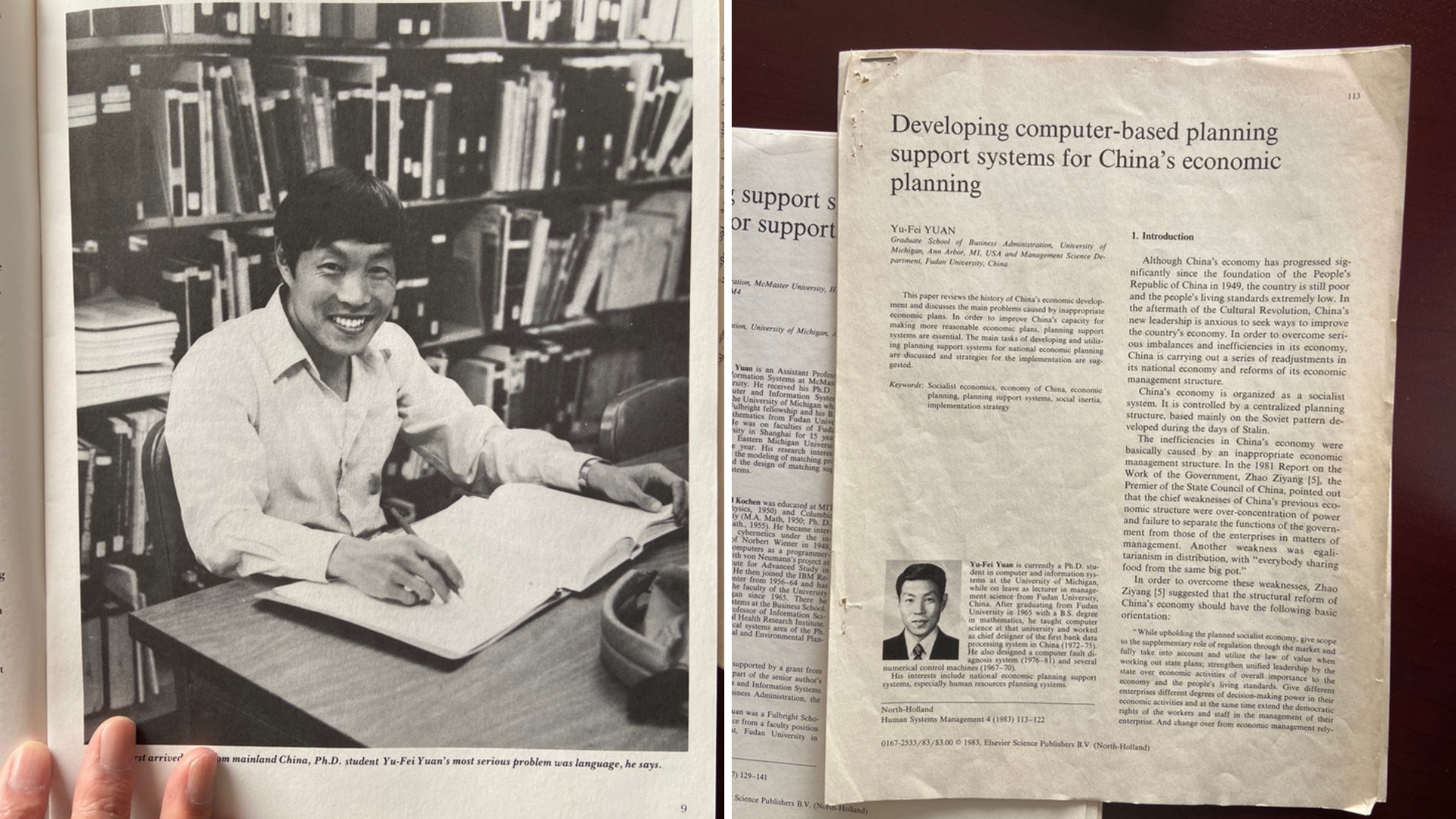
At age 25, armed with an undergraduate degree in mathematics, he designed a numerical control machine built with semiconductor technology. By age 30, he’d developed a computer system using small-scale integrated circuits for a bank. It was the middle of the Cultural Revolution, the country was closed, and Chinese banks were still using the abacus. “I wanted to break those barriers. We spent three years, built a computer, built an operating system, and wrote the program,” he says.
“Each of these experiences reinforced a central question that has guided my scholarly work ever since: How can new waves of information technology be harnessed to create meaningful benefits for society?”
Yuan believes AI can complement human labour—but humans will need to adapt. “AI does not “take” jobs; instead, people who know how to use AI will replace people who do not use AI,” he says.
His most-highly cited paper—it boasts a whopping 1182 citations at the time of writing—is about the “induction of fuzzy decision trees,” a method used in machine learning for classifying imprecise or vague human information, published back in 1995.
Thirty years later, Yuan is still publishing at a furious rate. His latest work examines how AI can be used to improve research and services—such as using AI to assist in risk analysis, and AI-empowered social media marketing. He is also conducting a study on AI-assisted health care that tackles an old health care problem: family doctors do not have time to listen to elderly patients for hours and might miss key information. “But ChatGPT is very patient,” says Yuan.
We asked Yuan about his career and his view on the role of AI in the workforce.
Looking at the arc of your career, what are some overarching questions your work has always considered?
Throughout my career, I have been driven by a deep curiosity about how emerging information technologies can transform human life and organizational practice.
When I had the opportunity to study for a PhD in the United States, I deliberately chose the then new field of computer information systems because it allowed me to explore not only the technical dimensions of computing but also its organizational and societal implications.
Across decades of technological change—from early computing to the internet, mobile systems and now AI—I have remained focused on understanding how innovation can be used thoughtfully, responsibly and creatively to improve the way people work and live.
Why are you personally interested in AI?
AI fascinates me because it represents one of humanity’s most ambitious intellectual undertakings: the effort to design systems that can emulate aspects of human cognition and perform tasks once believed to require unique human intelligence. The possibility that we can build tools capable of perception, reasoning, and learning is both inspiring and humbling. My interest lies not only in the technology itself, but also in what it reveals about human ingenuity and our ongoing drive to extend our capabilities through innovation.
My engagement with AI began early in its modern history. I developed a fuzzy logic rule induction algorithm for machine learning and built an expert system to support kidney transplant assignment—an experience that showed me how computational reasoning could assist with complex, high-stakes decisions.
Later, I evaluated the performance of neural networks for financial analysis, exploring how machine learning models could uncover patterns beyond traditional statistical methods. Most recently, my work has focused on understanding how AI agents affect knowledge workers and how generative AI can be used to support qualitative data analysis.
Across these different phases, my interest in AI has remained consistent: I am drawn to the ways AI can augment human intelligence, expand our problem-solving capacity and open new possibilities for research and practice.
How can AI assist humans rather than replace them?
AI is a human creation, and it is ultimately humans—not the technology—who determine how it is used. When I say that jobs are not replaced by AI, I mean that technology itself does not eliminate the work people do, by choosing how to use technology and by reorganizing work around it. AI is a tool, not an independent actor. It has no agency, intention, or decision-making power about the labor market.
Humans decide where to apply AI, how to redesign workflows, and what new skills become valuable.
A more accurate way to understand technological change is this:
- Tasks get automated, not entire professions.
- Roles evolve, rather than disappear.
- Workers who learn to use new tools often replace those who do not.
In this sense, AI does not “take” jobs; instead, people who know how to use AI will replace people who do not use AI. This pattern has repeated throughout history—from the introduction of calculators to spreadsheets to the internet. Each wave of technology changed the nature of work, but it also created new opportunities for those who adapted.
What role do you see AI ideally playing in the workforce?
Ideally, AI should take on tasks that are repetitive, time-consuming, or analytically intensive, freeing people to focus on higher-order work—creativity, judgment, empathy and strategic thinking. When used well, AI becomes a partner that enhances productivity, expands what individuals and organizations can accomplish, and opens new opportunities for innovation. The goal is not to substitute human intelligence but to augment it.
What can AI offer research scholars?
AI offers tremendous potential to enhance both the efficiency and the quality of scholarly research. It can help researchers process large volumes of information, identify patterns, generate ideas and explore new directions more quickly than ever before. These tools can accelerate literature reviews, support data analysis and even help scholars communicate their findings more effectively.
But the essence of research—curiosity, critical thinking, theoretical insight and the pursuit of new knowledge—remains fundamentally human. AI can support our work, but it cannot replace the intellectual rigor, creativity, and ethical judgment that define scholarly inquiry. What excites me most is the possibility of combining human insight with AI-enabled capabilities to push the boundaries of what research can achieve.