

STRATEGIC PLAN | ENGAGING COMMUNITIES STUDENT
Sustainability demands action
December 2, 2025 ·
Contributed by: Jun Xian (John) Li
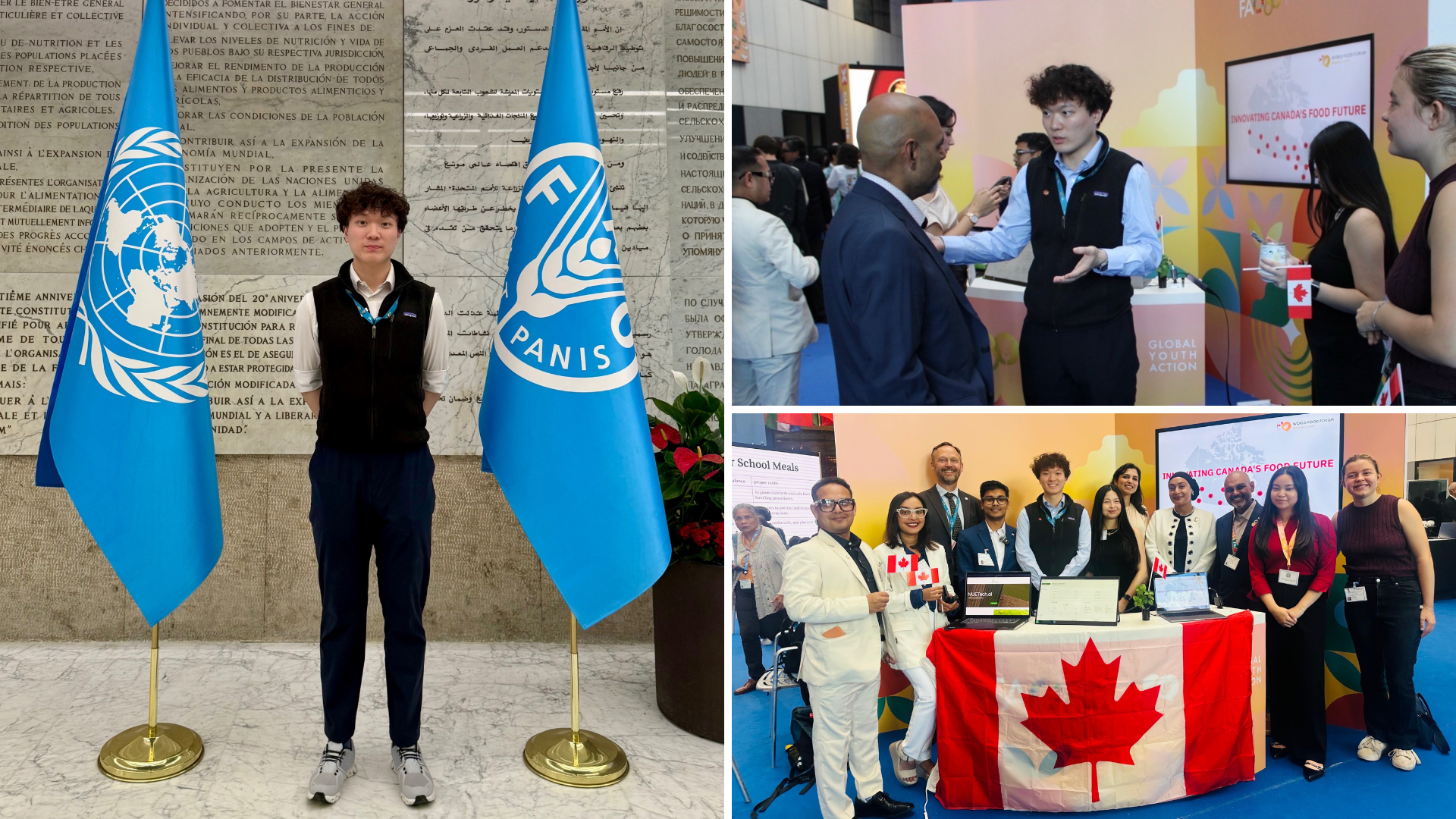
I recently participated in the Global Youth Action Track at the 2025 World Food Forum in Rome — an international platform that brought together young leaders, policymakers, investors, scientists and Indigenous communities to shape the future of sustainable and resilient food systems.
Throughout the week, one thing became very clear: sustainability is no longer a distant ideal — it is the foundation of our shared future. As youth, we are not bystanders in this global dialogue: we are co-architects of change. The future we’re discussing is our future — and the lives of generations that will follow depend on the choices we make today.
From climate adaptation and water governance to Indigenous knowledge and ethical leadership, every conversation I engaged in carried the same message: we cannot afford to wait. Being green and being responsible must become part of who we are — not just as individuals, but as institutions and nations.
During the Food and Agriculture Organization’s (FAO) 80th-anniversary celebration, Pope Leo XIV reminded world leaders that “food must never be a weapon,” calling global hunger an “ethical derailment and a historical fault.” FAO Director-General Qu Dongyu echoed that peace and the right to food are inseparable, and that transforming our agrifood systems requires collective will and investment in systemic change. For me, hearing this reinforced that sustainability is not an abstract global goal — it is a moral and human imperative that demands both knowledge and action.
As a McMaster student, I believe this is a call to action for all of us — not just within DeGroote, but across every faculty. We cannot sit and wait to be fed by a silver spoon while the world changes around us. As Canadians, we are privileged to live in abundance, yet we continue to waste food, overconsume and underestimate our role in shaping a greener planet. Canada is the seventh largest agricultural exporter in the world — supplying wheat, grains and pork to global markets. As a nation so deeply tied to global food systems, we have both the capacity and the responsibility to lead sustainable practices and take these dialogues more seriously. For McMaster, this is a chance to redefine what leadership means — to produce graduates who don’t just succeed in their fields, but who also lead responsibly in the face of climate and social challenges.
It’s also worth noting that sustainability now shapes how institutions are evaluated globally. For example, QS World University Rankings have recently expanded their criteria to include sustainability and ESG indicators — areas where McMaster has room to grow. While rankings aren’t everything, they reflect an important shift: being a top university today means not only producing knowledge, but living the values of sustainability, equity and social responsibility.
From this experience, I’ve also realized how interconnected all the UN Sustainable Development Goals are. We need to advocate for Zero Hunger (SDG 2), even in a developed country like Canada, there are still people who go to bed hungry — many of whom face systemic challenges that trace back to the lack of Decent Work and Economic Growth (SDG 8). This, in turn, is often rooted in deeper inequalities and social divides (Reduced Inequalities SDG 10) — whether lack of opportunities or access to financial and institutional support.
To address these issues, we must build Sustainable Cities and Communities (SDG 11) that prioritize not just environmental resilience but also social inclusion and equity. These are challenges we encounter daily in our urban lives, but they’re magnified by the realities of Climate Action (SDG 13) — a crisis that hits close to home when we experience record-breaking heat waves and increasingly frequent wildfires. As McMaster pushes itself to be the best version of itself, we should also embody Peace, Justice and Strong Institutions (SDG 16) — because only when we are strong as a community can we make the greatest impact on those we seek to help.
As the world shifts toward sustainability, students should inform ourselves to be better and more holistic global citizens. Although my own career trajectory is rooted in traditional finance, within the corporate sector, firms have been shifting their focus toward sustainability and Environmental, Social and Governance (ESG) factors as investors and shareholders become increasingly conscious of these factors. But the fact that shareholders want us to move in this direction should not be the sole driver of change.
I believe I need to capitalize on every opportunity to learn and act on these matters, and I encourage every McMaster student to do the same. Together, we can create and build a Brighter World , not just as a slogan, but as a shared purpose.
To truly embody these values, McMaster students must take a holistic approach — learning about sustainability and ESG in our classrooms and taking real-world action beyond them. We need to empower each other to be keeners, go-getters and responsible global citizens. Understanding sustainability benefits us all — from the air we breathe to the food we eat and the communities we build.
I hope to continue bringing these global insights into conversations here on campus. I am eager to explore how we, as a university, can take greater steps toward embedding sustainability and global citizenship into our programs, student experiences and institutional identity.