


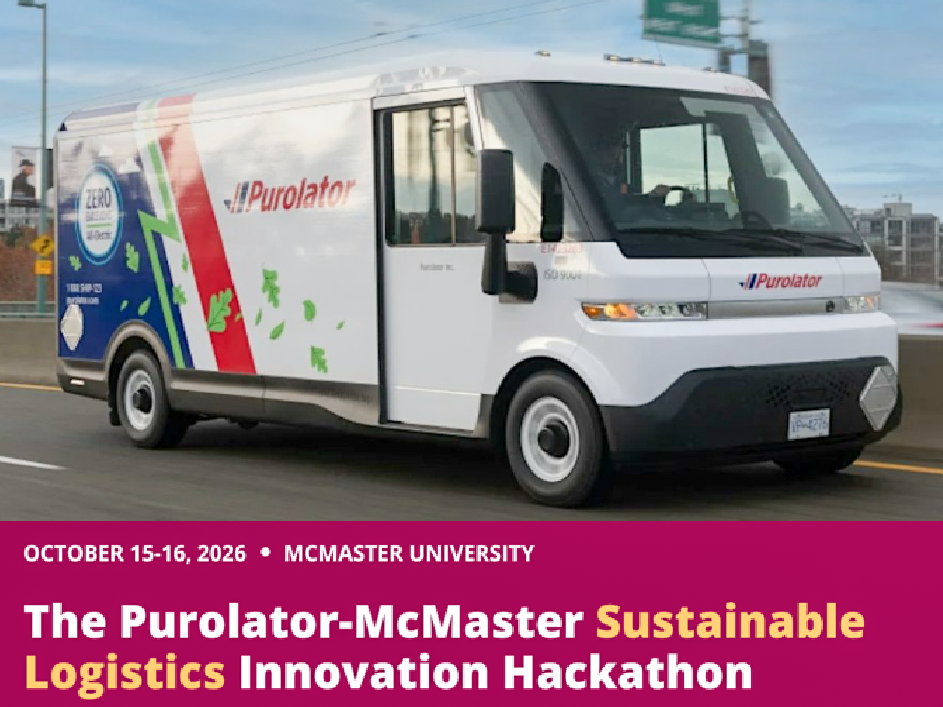
Purolator – McMaster Hackathon
A unique opportunity for students to solve a real industry challenge, test your skills, network with professionals, and collaborate in diverse, multidisciplinary teams from across McMaster.
Register
When
October 15, 2026 to October 16, 2026
10:00 a.m. to 5:00 p.m.
Where
Sustainable Futures Hub, MCCD 8120
Cost
Free - Registration Required
Includes Lunch
Two-day interdisciplinary hackathon
Join the Purolator Chair in Sustainable Logistics and Supply Chain Management at the Sustainable Futures Hub (MCCD 8120) for a two-day hackathon focused on sustainable EV battery lifecycle management.
Working in interdisciplinary teams, participants will develop data-driven models, analytical tools, and actionable business insights to address a real-world EV battery lifecycle challenge.
Compete for an internship interview opportunity with Purolator, the chance to present to Purolator executives, and additional awards recognizing excellence in AI, sustainability, and real-world impact.
The Challenge: How can Purolator use EV battery State of Health (SOH) to predict when a battery should be retired from active fleet service and determine whether its remaining capacity can be repurposed to support EV charging at a terminal?
About the Challenge: As transportation fleets transition toward more sustainable technologies, organizations must make complex decisions about EV batteries and components reaching their end-of-life.
A battery that is no longer suitable for its existing vehicle may still have operational, financial, or environmental value. Depending on its condition, remaining capacity, safety profile, lifecycle cost, and potential applications.
During this two-day hackathon, students will work on developing a practical, data-driven battery lifecycle tool that estimates battery health and remaining useful fleet life, predicts when a battery will reach a defined fleet end-of-life threshold, and evaluates the value of repurposing eligible batteries as second-life stationary energy storage. The solution should quantify the potential operational and financial benefit to Purolator, including estimated electricity cost savings.
Teams will explore how operational data, AI, business insights, financial analysis, and sustainability criteria can help decision-makers evaluate end-of-cycle batteries and determine the most appropriate pathway.
RegisterContact
MBA Operations Management Club ( mbaopsmg@mcmaster.ca )