

ALUMNI STRATEGIC PLAN | ENGAGING COMMUNITIES STUDENT
Community-led entrepreneurship starts with listening
January 28, 2026 ·
Contributed by: Angelica Babiera
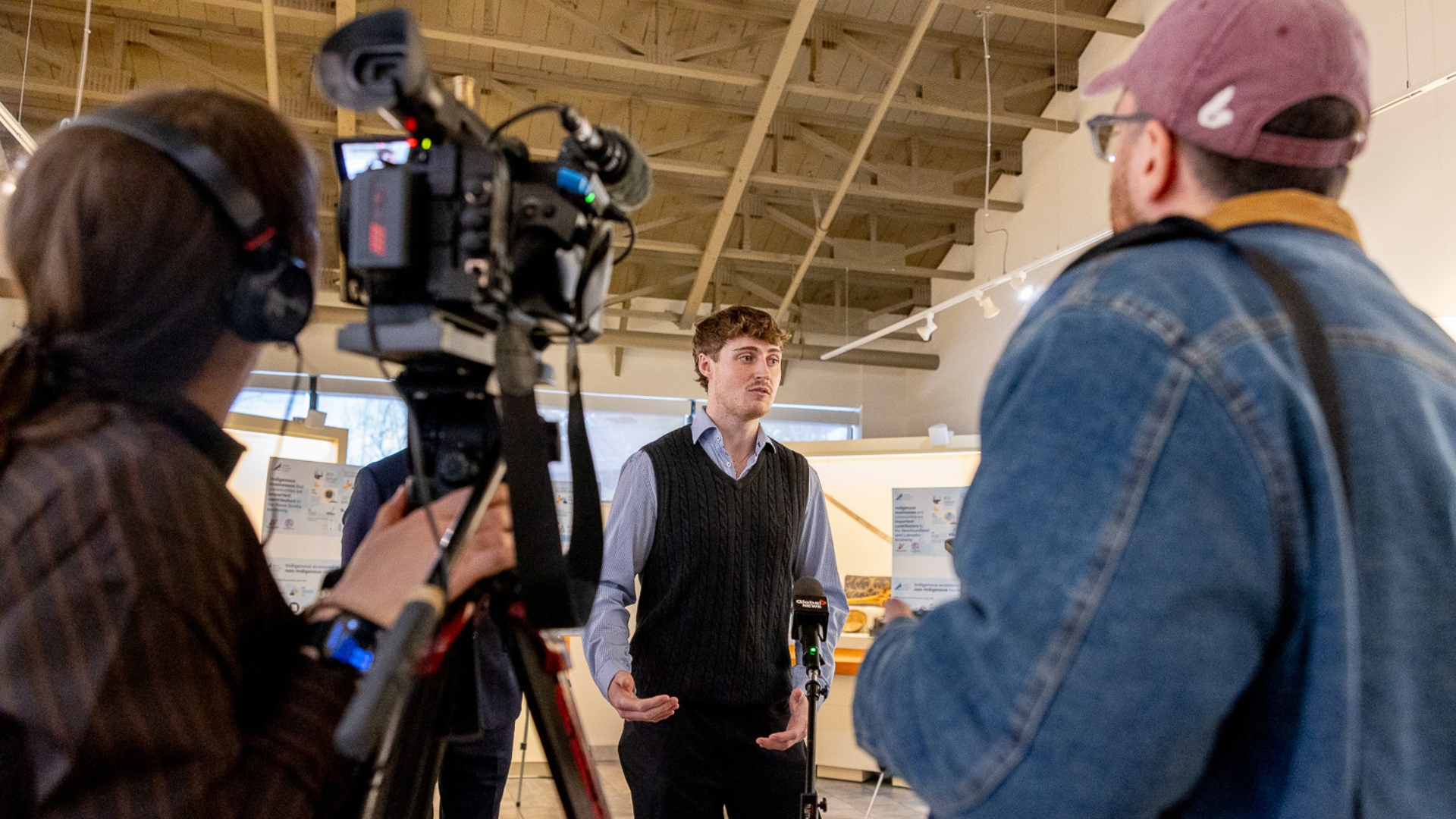
Jackson Wilms is careful with certainty.
When he talks about his work, he pauses—not out of hesitation, but attention. Ideas are tested aloud, sometimes revised mid-sentence. He has learned that moving too quickly can be harmful. In the work he does now, listening is not a courtesy or a soft skill. It is a responsibility.
Wilms is a project manager at SeafarerAI, an environmental monitoring startup based in New Brunswick and co-founded by his father Ian Wilms. The company develops AI-powered systems designed to detect environmental harm as it happens, particularly in maritime environments where damage can go unnoticed until it is irreversible. Increasingly, that work has brought Wilms into close, ongoing collaboration with local Indigenous communities—relationships that require far more than technical expertise.
Much of what guides him in this work was shaped by his time in the Integrated Business and Humanities (IBH) program.
“The program really taught me that you don’t go into communities thinking you know how to help,” Wilms says. “You go in ready to learn.”
Although IBH is structured around four pillars (community engagement, global mindedness, leadership and social enterprise) Wilms no longer thinks of them as distinct ideas. “I don’t really see them as four pillars anymore,” he says. “They’ve just become who I am.”
That shift forced him to reckon with how little he knew growing up. In Canada, Wilms says, Indigenous histories and realities were largely absent from his education. “Most of our education system is designed not to talk much about Indigenous Peoples or Canada’s relationship with them,” he says. “You only know what you know. And if you don’t give yourself the capacity to learn more and expose yourself to ways of thinking that are different from what you were brought up with, you’re really limiting who you can become.”
This realization was uncomfortable but clarifying. Wilms began to understand that learning about Indigenous communities could not be delegated or rushed. “You can’t create these relationships overnight,” he says. “To truly understand, you have to listen, and you have to take time, and you don’t put the burden on communities to educate you. You take the time to learn on your own time, so that when you show up, you’ve already done part of the work.”
At SeafarerAI, that lesson shapes how partnerships are approached: by building trust, maintaining communication and ensuring Indigenous voices remain present as projects evolve. He says that Indigenous Peoples are subject matter experts when it comes to environmental stewardship. Since each Indigenous community is unique both culturally and ecologically, it is best practice to work with these communities to better understand their specific context, and how their environmental monitoring needs might alter their approach in what services SeafarerAI offers them.
“Our plan as this element of our business grows is to make sure that there is a strong training component that ensures community members can be proficient users of the technology, providing more local jobs that are aligned with looking after their community and environment,” Wilms says.
Although his work is grounded in New Brunswick, Wilms traces much of his approach to experiences that forced him to think beyond familiar contexts. During his undergraduate studies, he worked on projects with students at the University of Cape Town in South Africa, where he learned how quickly assumptions can fall apart once you step outside what you know. “What you think is a great solution in Canada might not work somewhere else,” he says. Differences in infrastructure, access and history matter.
That lesson travels easily across borders and back home. “If you’re not willing to see things through other lived experiences,” Wilms says, “you’re going to be proposing things that will never actually be adopted.”
Wilms has come to see entrepreneurship not as an exercise in confidence, but as a constant encounter with uncertainty. “Every day, there’s ambiguity,” he says. “At first, that was really uncomfortable. You want to know what’s coming next but it’s actually through discomfort that you grow the most. Letting go of needing to know what’s going to happen has made me a stronger version of myself.”
For Wilms, leadership is not about control or having the final word. “I’m a good leader when I bring people together,” he says. “When I help people feel comfortable contributing in ways that are meaningful.”
Wilms is wary of rhetoric that frames doing good as a branding exercise. “You can’t just say you want to do good,” he says. “Your actions actually have to reflect that intention.”
In his final year at McMaster, he completed a land acknowledgement for SeafarerAI as part of a social entrepreneurship course. The assignment required research into treaty relationships and reflection on what reconciliation looks like beyond symbolism. “A lot of what I wrote has actually manifested into my life,” he says.
Recently, Wilms co-authored the Artificial Intelligence and Atlantic Indigenous Economic Development report and spoke with Global News Atlantic. This report highlights the effects of artificial intelligence on Indigenous economic growth in the region and emphasizes how Indigenous communities themselves can shape responses and lead development on their own terms rather than having solutions imposed on them.
At SeafarerAI, those reflections translate into ongoing questions about supply chains, data use and environmental impact. It goes beyond simply what the technology can do, but what it should do and for whom it might impact.
Wilms is careful not to frame his work as heroic or complete. “I can’t fix what’s happening halfway across the world,” he says. “But I can have an immediate impact in my community.” He believes that to make positive change happen, you must start small and grow it in community with others, and that people working together towards the common good is where the magic happens.
That belief has become a through-line in how he works. He did not learn to arrive with solutions, he learned to arrive prepared: to listen closely, to reflect honestly and to build relationships grounded in respect.
“If I’m able to do good where I am,” Wilms says, “and build something grounded in reciprocity, then I feel like I’m doing the work I set out to do.”
Photo Credit: Johanna Matthews