

Navigating Ontario’s biggest overhaul to school governance
October 23, 2026 ·
Contributed by: Izabela Shubair
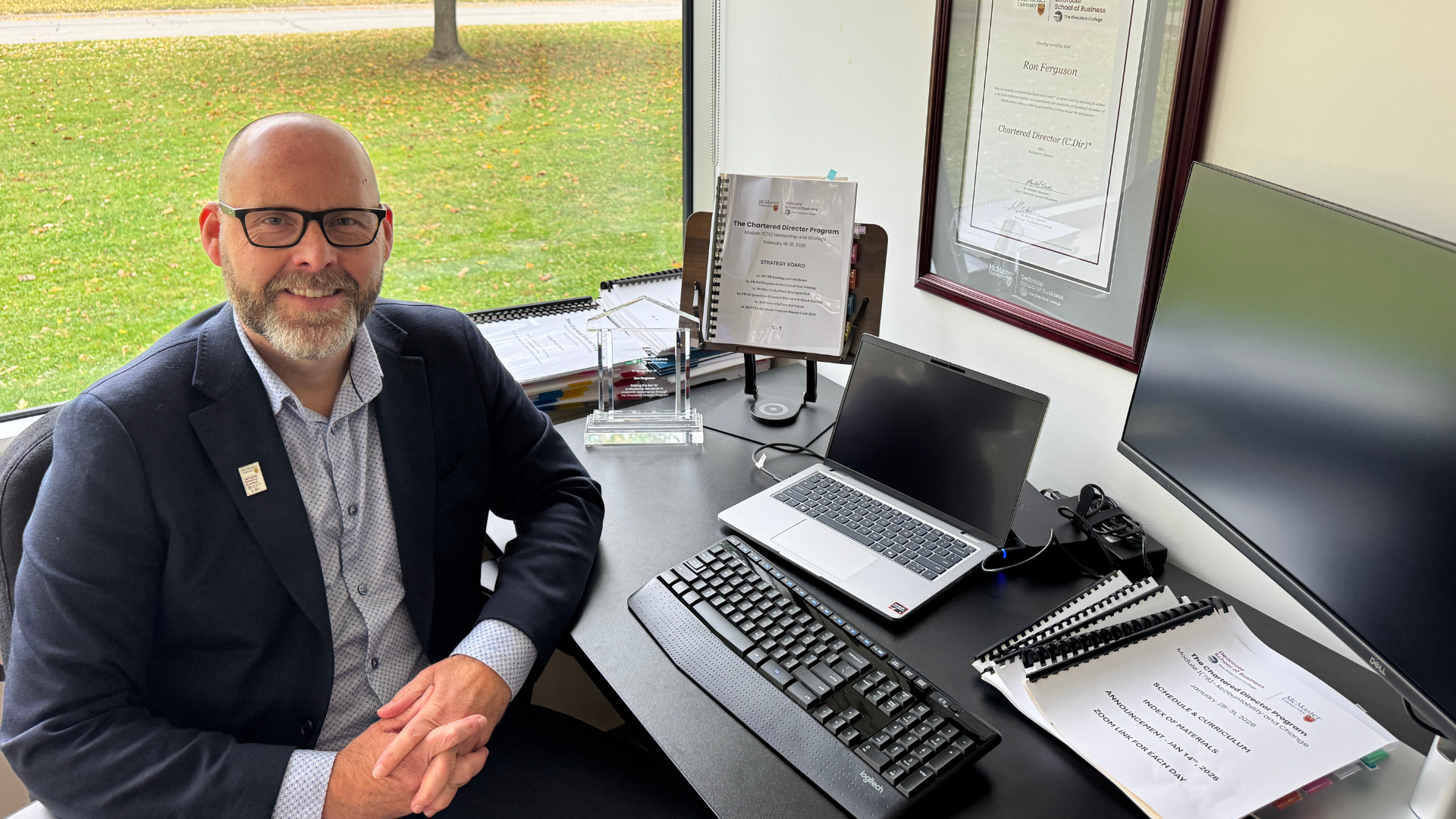
When Ron Ferguson enrolled in The Directors College’s Chartered Director program, he was preparing for major governance changes at the Upper Canada District School Board (UCDSB).
As UCDSB’s director of education and board secretary, Ferguson was working with the board’s leadership to anticipate the implications of what would later become Bill 101. They wanted to understand and prepare for what an overhaul of school governance would mean for the organization.
That preparation required more than considering what might shift on paper. Ferguson saw an opportunity to deepen his knowledge of effective governance — insight he could bring back to UCDSB as the province’s plans took shape.
“I had spent a decade going to board meetings, and I really learned on the job,” says Ferguson. “What the Chartered Director program did was give me the ability to share evidence with trustees that backed up best practices. I could be a kind of expert voice.
This is the biggest change to the governance structure of public education in Ontario since its founding. It was a consequential time, and getting it right was really important.”
Changing roles
Bill 101’s implications went beyond new governance rules. It also brought new expectations for how English-language school boards would approach leadership, accountability and operations.
The bill made a clearer distinction between the board’s governance role and the organization’s executive management. The director of education became the board’s CEO, responsible for leading the organization’s business side, including its financial and operational matters. Meanwhile, a newly created Chief Education Officer position focuses on educational leadership and student achievement — responsibilities that previously fell under the director of education’s role.
For Ferguson, the reforms separated responsibilities that had previously sat within a single role and altered his place at the board table. As director of education, he had served as UCDSB’s board secretary. Under the new governance structure, he became a non-voting board member, while elected trustees continued to provide governance and oversight.
“The bill passed as I was taking the program, so I was able to apply my knowledge in real time and get feedback from my professors on how to adjust to it with as little disruption as possible,” says Ferguson. “It was a team effort with the chair of the board and the board of trustees. I was the one taking the courses, but it was like all of us were taking them because we were able to navigate the changes more confidently.”
From principles to practice
One of the most useful lessons was learning to distinguish between governance and operations and the responsibilities that belong to each. At UCDSB, governance and operations sometimes intersected, raising questions about where a decision belonged and who should be responsible.
“Governance and operations were sometimes not in alignment,” Ferguson says. “We sometimes had staff making decisions that would perhaps fall better into governance, and the other side, governance being involved in operations. What I learned in the program helped me to speak with more certainty about these roles.”
The program also gave Ferguson perspective on how governance models can differ. That proved useful as UCDSB adapted to a new structure under Bill 101, which introduced new requirements around the relationship between the board and its CEO. Among other changes, the CEO can refuse certain motions or resolutions passed by the school board. The board must obtain the Minister of Education’s prior written approval before dismissing the CEO.
“Seeing how other organizations are governed and the fact that there is variance in governance structures helped me hold loosely what a board should be,” says Ferguson.
Ferguson was even able to apply the program’s lessons to specific governance functions. After course weekends, he sometimes returned to UCDSB and immediately put into practice what he learned in his committee meetings.
“The program was so real and so relevant that I sometimes stopped paying attention in class because I was already thinking about how I could apply what I was learning to make changes in my organization,” he says.
“I could now point to certain accounting principles and say, ‘Here it is, it’s not just my ideas.’”
Impact beyond UCDSB
Jamie Schoular chairs the UCDSB, which employs 4,200 staff and serves over 28,000 students across 77 schools. He says Ferguson’s training has been a valuable resource for the board of trustees. It has helped confirm where the board was already following good governance practices while also identifying areas where its approach could be strengthened.
The value of Ferguson’s experience, Schoular says, also extended to his work as board chair of Student Support Ontario. The entity administers student nutrition programs across eight school districts.
“Ron recognized that there were aspects that were not aligned with good governance practice and with pertinent legislation,” he says. “One of those was eligibility for membership on the board of directors. With his guidance, we were able to make the necessary changes that brought us into proper alignment.”
The Chartered Director program’s impact has continued beyond the immediate governance transition.
Having completed the program in May 2026, Ferguson still references his course materials regularly as UCDSB adjusts to the province’s changes and awaits additional regulations. During the program’s Oversight and Finance Module, Ferguson also noticed gaps in his financial and accounting knowledge — an area also relevant to his role as CEO. That realization led him to pursue DeGroote’s EMBA in Digital Transformation.
“Although I learned an incredible amount through the program, it also identified gaps in my professional practice that I needed to address, which is how I ended up in the EMBA,” Ferguson says. “So, I can’t think of a more useful and beneficial program that I could have been enrolled in while these changes were happening in the province of Ontario.”